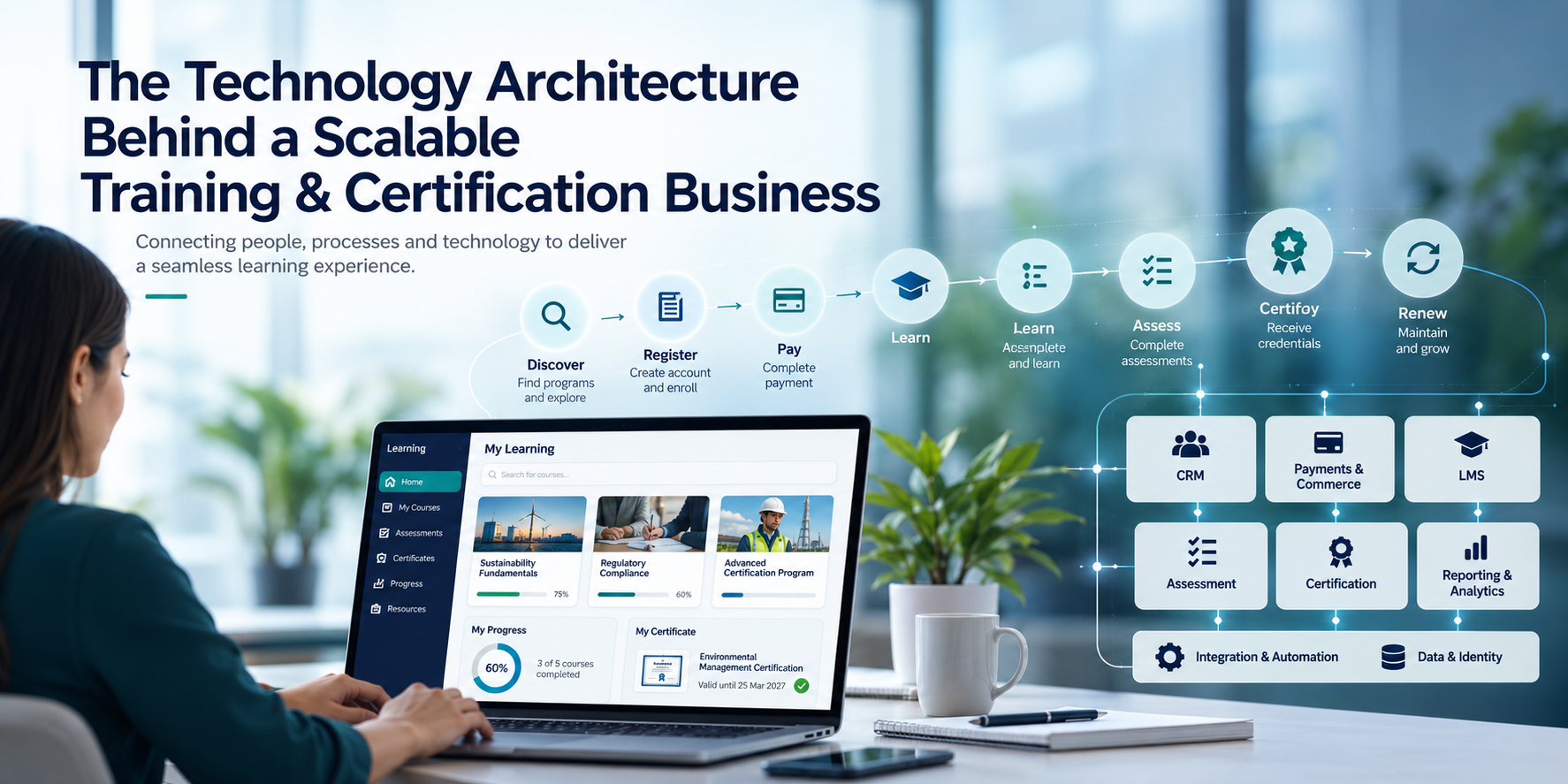
Why growing training organizations need to look beyond the LMS—and how connected workflows, integrations, and practical technology decisions can reduce operational complexity.
A training and certification business can start with a relatively straightforward operating model which is: Learners register for courses, access learning materials, complete assessments, and receive certificates.
As the business grows, the technologies supporting these activities becomes more complex; New programs introduce different eligibility rules, Customers expect convenient registration and payment experiences, Certification programs require assessments, credential tracking, and renewals. Business leaders need reliable reporting, while administrators must coordinate information across multiple systems.
With all these, organizations often respond by introducing additional software: a learning management system (LMS), customer relationship management (CRM) platform, payment gateway, assessment tool, credentialing system, or reporting application.
Each addition helps solving a specific problem but the organization can still find itself managing duplicate records, manually updating enrollment statuses, reconciling spreadsheets, and troubleshooting disconnected workflows.
The issue is not that the individual applications are inadequate but the real challenge is whether the technology environment supports the complete business process. For training and certification organizations planning to scale, that distinction is fundamental.
An LMS Is Not the Entire Training Business
When an organization decides to modernize its learning operations, the discussion often begins with an LMS to deliver courses, track learning progress, manage administrative tasks.
But the main point is organization operates beyond the LMS.
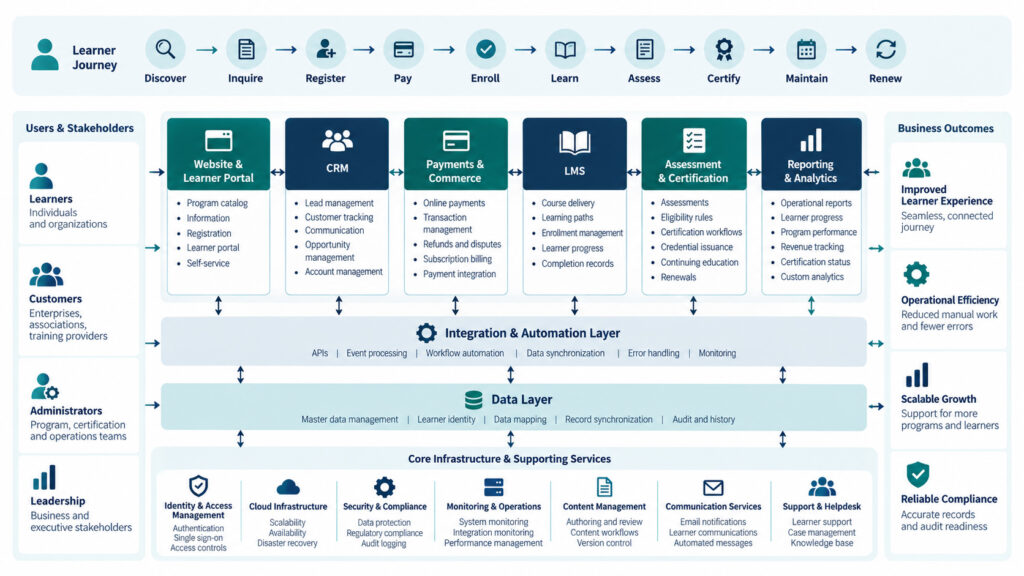
A prospective learner may discover a program through a website, submit an inquiry, register, make a payment, receive learning access, complete an assessment, earn a credential, and return later for continuing education or renewal. A simplified learner journey looks like this:
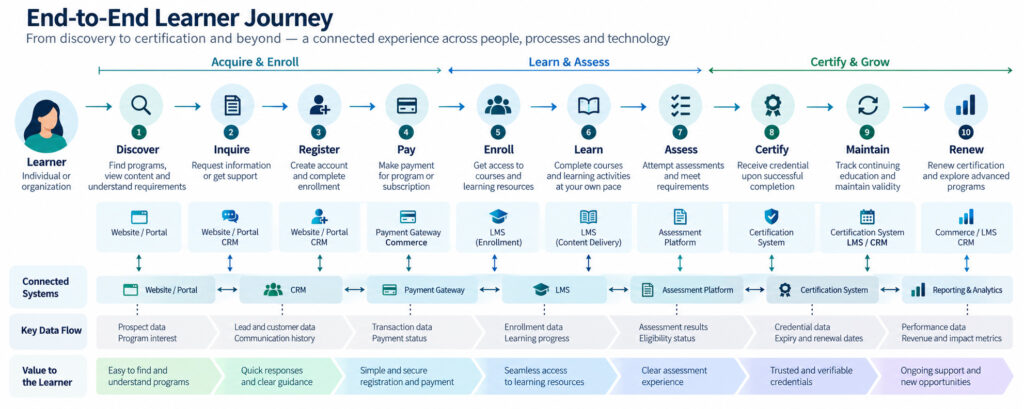
Different systems may support different stages.
A website manages program information. A CRM maintains customer relationships. A payment system records transactions. An LMS delivers training. Assessment and credentialing applications manage qualification requirements. Reporting tools provide operational visibility.
The learner, however, expects one coherent experience.
A payment that has been successfully processed should not require the learner to contact support for access. An assessment result should not disappear between the learning platform and the certification system. A valid credential should not appear expired because renewal information failed to synchronize.
These are not simply LMS feature requirements. They are end-to-end operational requirements. This is why technology architecture should begin with the business and learner journey, not a product comparison.
Where Growing Training Organizations Experience Complexity
Technology fragmentation is not always immediately visible.
An organization may continue delivering courses successfully while accumulating small operational inefficiencies.
Consider a few common situations.
Duplicate Learner Records
The same learner exists in the CRM, LMS, assessment platform, and credentialing system, but the records are not reliably linked.
Staff must identify which information is current and correct inconsistencies manually.
Manual Enrollment After Payment
A learner completes a transaction, but an administrator must confirm payment and activate course access.
This may be manageable at low volumes. As enrollment increases, the process can become a bottleneck.
Disconnected Reporting
The training team exports course completion data from the LMS. The finance team uses payment reports. Certification administrators maintain another dataset.
Producing a complete picture of program performance requires reconciliation across spreadsheets.
Certification & Renewal Tracking
A learner completes the required training and assessment, but certification status, continuing education records, and renewal eligibility are maintained separately.
Administrators become responsible for transferring information between systems.
Uncoordinated Content Workflows
Training organizations that also develop or publish learning content may need to coordinate authors, reviewers, editors, approvers, and production teams.
Without a defined workflow, content can move between people through email, spreadsheets, and disconnected applications.
The common problem is not necessarily a lack of software.
It is the absence of a clearly designed process connecting people, systems, and information.
A useful question for leadership is:
If learner volume doubled tomorrow, which administrative activities would require twice as much human effort? The answer often reveals where modernization should begin.
The Core Technology Components
There is no universal technology stack for every training provider.
A corporate learning department, professional certification body, membership association, and commercial training business may have different requirements.
However, a growing training and certification environment commonly involves several connected capabilities.
Learner Experience & Customer Management
This includes the website, course catalog, registration process, customer portal, and CRM.
The objective is to support the relationship with the learner or customer before, during, and after training.
A CRM may be particularly important when the organization serves enterprise customers, manages inquiries, tracks commercial opportunities, or supports recurring customer relationships.
Commerce, Payments & Enrollment
The payment system does more than collect money.
A successful transaction may need to initiate account provisioning, enrollment, permissions, communications, and reporting updates.
The organization must also define what happens when a payment is refunded, canceled, disputed, or only partially completed.
Learning Management
The LMS manages course delivery, learning paths, learner progress, completion records, and relevant administrative activities.
It remains a core platform, but its responsibilities should be clearly defined.
Not every business process needs to be implemented inside the LMS.
Assessment & Certification
Course completion and professional certification are not always equivalent.
A certification program may require eligibility verification, multiple assessments, minimum passing scores, practical evaluation, or continuing education.
These rules should be represented in reliable workflows and records.
Identity & Access Management
Learners may interact with multiple platforms using the same organizational identity.
Account provisioning, authentication, single sign-on, access permissions, and record matching all need attention.
Without a consistent identity model, integrations can create duplicate users or assign access incorrectly.
Integration & Automation
Integration enables information to move between systems.
Automation uses business rules and events to trigger appropriate actions.
For example:
- Payment confirmed → learner enrollment activated
- Course completed → assessment eligibility updated
- Assessment passed → certification process initiated
- Credential approaching expiry → renewal workflow triggered
These workflows depend on the organization’s actual policies and system capabilities.
Data, Analytics & Reporting
Leadership may need to understand enrollment trends, program completion, assessment outcomes, certification status, revenue, and renewal activity.
Reliable reporting requires agreement on where data originates, how it is updated, and how different records relate to one another. The architecture should support operational decisions, not merely produce more dashboards.
Integration Is More Than Connecting APIs
It is tempting to view integration as a technical activity that begins once the applications have been selected.
In practice, integration decisions should be part of the architecture from the beginning.
Before connecting two systems, several questions need answers.
Which system owns the learner’s primary record? Where is payment status authoritative? Which application determines certification eligibility? What happens when information changes? How should conflicting records be resolved?
These questions establish data ownership and workflow responsibility.
Consider a learner purchasing a certification program.
The payment platform confirms the transaction. The learner identity must be recognized or created. The appropriate program enrollment must be established. Access permissions must be applied. Confirmation should be sent, and the transaction should be reflected in reporting.
Now consider the exceptions.
What happens if the payment succeeds but the LMS is temporarily unavailable?
What happens if the learner already has an account?
What happens if an integration retries the same event?
What happens when an administrator needs to correct a transaction?
A reliable architecture considers these conditions before they affect learners.
Depending on the systems involved, the solution may require event processing, retries, monitoring, reconciliation, error queues, administrative controls, or a documented recovery procedure.An integration is not complete simply because data can move from one application to another. It must support the business process reliably, including when something goes wrong.
Certification Is a Lifecycle, Not a Certificate File
For professional certification organizations, the technology challenge extends beyond learning delivery and assessment.
A certification may involve:
Eligibility → Learning → Assessment → Result → Certification → Credential → Continuing Education → Expiry → Renewal
Each stage can have distinct requirements.
A learner may need to complete prerequisites before accessing an assessment. A passing result may require additional verification. A credential may have a defined validity period. Renewal may depend on continuing education credits, another assessment, payment, or administrative approval.
If these rules are maintained across disconnected systems, administrators must manually establish whether a learner remains eligible or certified.
A connected certification architecture should make the relevant status and supporting records available to authorized people and systems.
It should also preserve the historical information needed to explain when a credential was issued, why its status changed, and whether renewal requirements were satisfied. This becomes increasingly important when the organization operates multiple certification programs with different rules.
Why Replacing the LMS May Not Solve the Problem
When training operations become difficult to manage, replacing the LMS may appear to be the most direct solution.
Sometimes replacement is justified. A platform may no longer meet functional requirements, may be difficult to maintain, or may lack capabilities essential to the organization’s future plans.
But replacement should follow diagnosis, not precede it.
Before recommending a technology change, three questions deserve attention:
What is the actual problem?
Is the organization struggling with learning delivery, learner access, reporting, certification workflows, integration, administrative effort, or something else?
What outcome does the organization want?
Does it need faster enrollment, fewer manual tasks, better data accuracy, improved learner experience, stronger compliance controls, or the ability to support more programs?
What resources are available?
What are the financial, technical, operational, and time constraints? What existing systems and capabilities can be retained?
These questions help determine whether the appropriate response is workflow redesign, configuration, integration, targeted customization, automation, or replacement.
An organization might discover that its LMS performs course delivery effectively, while the actual problems originate in payment-to-enrollment handoffs or disconnected certification records.
Replacing the LMS without addressing those processes could reproduce the same problems in a new environment. The better principle is to select the minimum sufficient solution that addresses the business requirement reliably.
A Practical Approach to Modernization
For organizations with existing technology investments, modernization does not need to begin with a large replacement program.
A staged approach is often more practical.
Understand
Clarify the operational problem and its consequences.
Distinguish between what stakeholders initially request and what the organization actually needs to achieve.
Map
Document the complete workflow.
Identify the systems, people, records, business rules, and decisions involved at each stage.
Simplify
Look for unnecessary approvals, duplicated data entry, overlapping responsibilities, and avoidable manual handoffs.
Automating a poorly defined process may simply make the complexity harder to see.
Integrate
Establish clear data ownership and connect systems where information needs to move.
Consider identity, permissions, synchronization, and exception handling.
Automate
Automate repeatable activities once their triggers, rules, and failure paths are understood.
Examples may include enrollment activation, assessment eligibility updates, credential notifications, and renewal reminders.
Replace Where Justified
Evaluate platform replacement when the existing technology cannot reasonably meet requirements or when the long-term costs and risks of retaining it outweigh the benefits. This sequence does not imply that every organization needs every step. It provides a disciplined way to make decisions without assuming that more software is always the answer.
Engineering Quality Determines Operational Reliability
Training platforms are often evaluated through functional demonstrations.
A course launches. A learner completes an activity. A certificate is generated.
These tests are useful, but they do not establish whether the entire business process will operate reliably.
End-to-end quality assurance should include scenarios such as:
- A new learner registers, pays, and receives the correct access
- An existing learner purchases an additional program without creating a duplicate account
- An assessment result updates the correct certification record
- A failed integration is detected and recovered without duplicating transactions
- A renewal changes credential status correctly
- Authorized administrators can trace and resolve inconsistent records
The quality of the overall experience depends on these transitions.
As systems evolve, regression testing becomes important. A change in one platform should not silently break enrollment, reporting, certification, or other connected workflows. Architecture documentation, monitoring, testing, and operational ownership are therefore part of scalability—not activities to consider only after launch.
How to Evaluate Whether the Architecture Can Scale
Scalability is often discussed in terms of server capacity, system performance, or the number of concurrent users.
Those factors matter, but training businesses also need operational scalability.
A platform may technically support thousands of additional learners while requiring administrators to manually process each new enrollment, certification update, or renewal.
A useful assessment should examine several dimensions:
| Dimension | Key Question |
| Learner experience | Can learners move through the complete journey without unnecessary delays? |
| Process efficiency | Which activities still depend on manual intervention? |
| Data integrity | Are learner, assessment, and credential records consistent? |
| Integration reliability | Can failed transactions be detected and recovered? |
| Flexibility | Can the organization introduce new programs and rules without excessive redevelopment? |
| Reporting | Can leaders obtain reliable information without manual reconciliation? |
| Maintainability | Can the architecture evolve without creating excessive dependencies? |
| Economics | Does the cost of supporting growth remain sustainable? |
The objective is not to eliminate all human involvement.
Some activities require professional judgment, learner support, or formal approval.
The objective is to remove unnecessary administrative effort while preserving appropriate oversight.
Start With a Learner Journey Audit
Before initiating a major technology project, a training organization can perform a relatively simple diagnostic exercise.
Select one representative program.
Follow the learner from initial inquiry through registration, payment, enrollment, learning, assessment, certification, and renewal, where applicable.
At every stage, ask five questions:
- Which system or team owns this step?
- What information is created or updated?
- Where does that information need to go next?
- Which activities require human intervention?
- What happens if the process fails?
Record the answers in a workflow map.
Identify duplicate records, spreadsheet dependencies, manual transfers, inconsistent statuses, and points where a learner or administrator must wait for another system or team.
Prioritize the findings according to business impact.
Some improvements may involve process clarification or configuration changes. Others may require integration, automation, or platform modernization.
The important outcome is a clear understanding of the problem before committing to a solution.
Building a Technology Ecosystem That Supports Growth
A modern training and certification business does not necessarily need the largest collection of software products.
It needs technology that supports how the business actually operates.
The LMS manages learning. The CRM supports customer relationships. Payment systems manage transactions. Assessment and credentialing systems support qualification requirements. Integrations, automation, data management, and operational controls connect the activities into a reliable service.
As learner volume, program complexity, and business requirements increase, these connections become more important.
A scalable architecture should allow the organization to introduce programs, serve additional learners, and evolve its services without a proportional increase in manual administration.
That requires more than software selection.
It requires understanding the business, designing the workflows, assigning clear system responsibilities, and making technology decisions that remain practical over time.
The goal is not to build the most sophisticated technology stack. It is to build the right technology environment for the business and the people it serves.
About OWLSystems Solutions
OWLSystems Solutions provides software engineering, solution architecture, systems integration, quality assurance, and technology delivery services. Its approach emphasizes understanding business requirements, evaluating existing technology investments, and designing practical solutions that can evolve with organizational needs.
For training and certification organizations, this perspective applies to learning platform integration, enrollment workflows, assessment and credentialing processes, data synchronization, automation, and the engineering practices needed to maintain connected systems.
Planning to modernize a training or certification technology environment? Start by examining the complete learner journey and identifying where disconnected systems or manual workflows are limiting your operations.