Introduction
Many organizations approach accessibility only when a compliance requirement appears.
A customer asks for a VPAT.
A procurement team requests WCAG conformance.
A legal team raises concerns about regulations.
At that point, accessibility becomes a project.
The challenge is that accessibility is not a project. It is a quality attribute of digital products, just like security, performance, reliability, and maintainability.
Organizations that treat accessibility as a late-stage compliance exercise often face costly remediation efforts, delayed releases, and inconsistent user experiences.
The Compliance Trap
Many teams focus on questions such as:
- Are we WCAG compliant?
- Do we have an accessibility statement?
- Can we pass an audit?
While these questions are important, they often miss a more fundamental issue:
Is accessibility part of how we engineer software?
When accessibility is addressed only before launch, teams frequently discover:
- Keyboard navigation issues
- Screen reader barriers
- Poor form usability
- Inaccessible custom components
- Mobile accessibility challenges
Fixing these issues late in the delivery cycle is significantly more expensive than preventing them during development.
Accessibility and Engineering Quality Have the Same Goals
High-performing engineering teams already care about:
- Consistency
- Scalability
- Maintainability
- Reliability
- User experience
Accessibility supports all of these goals.
For example:
A properly structured heading hierarchy improves both accessibility and maintainability.
Clear form validation benefits all users, not only those using assistive technology.
Keyboard support improves usability for power users and accessibility users alike.
Accessibility improvements often result in better overall product quality.
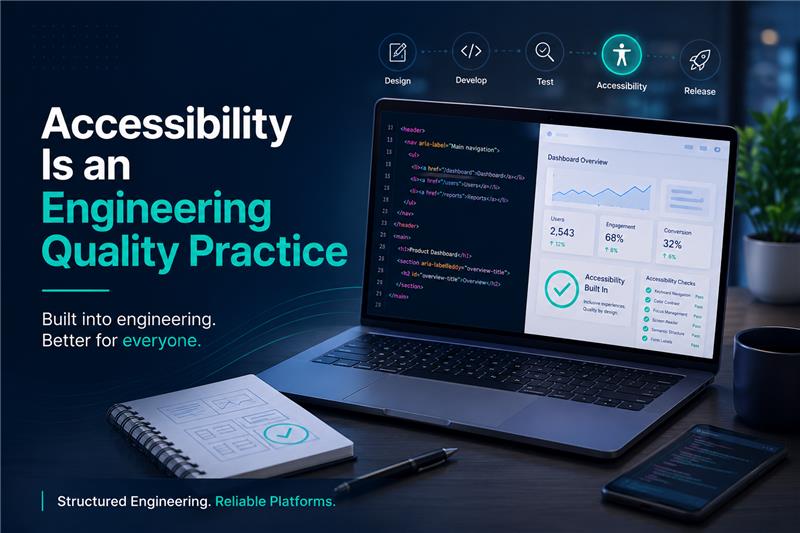
Accessibility Should Be Embedded Across the Delivery Lifecycle
Accessibility becomes sustainable when it is integrated into every stage of delivery.
Discovery
- Identify user needs
- Define accessibility requirements
Design
- Accessible design systems
- Color contrast validation
- Focus management planning
Development
- Semantic HTML
- Accessible components
- Keyboard interaction support
Testing
- Automated testing
- Manual accessibility reviews
- Screen reader validation
Operations
- Ongoing monitoring
- Regression prevention
- Continuous improvement
Accessibility Is Not Only About Disability
Accessibility benefits:
- Mobile users
- Older users
- Temporary impairments
- Low-bandwidth users
- Keyboard users
- Power users
Inclusive design creates better experiences for everyone.
What Engineering Leaders Should Do Next
Engineering leaders should begin asking:
- Is accessibility included in our definition of done?
- Are developers trained on accessibility fundamentals?
- Is accessibility part of code review?
- Do we test with assistive technologies?
- Do we monitor accessibility after launch?
These questions shift accessibility from compliance activity to engineering discipline.
Conclusion
Organizations that view accessibility solely as a compliance requirement often struggle with expensive remediation efforts and inconsistent user experiences.
Organizations that treat accessibility as an engineering quality practice build more resilient, scalable, and inclusive digital products.
Accessibility should not be something added at the end of development.
It should be engineered into the product from the beginning.
Building accessible digital products requires more than an audit.
OWLSystems helps organizations integrate accessibility into product engineering, platform development, and ongoing delivery processes.