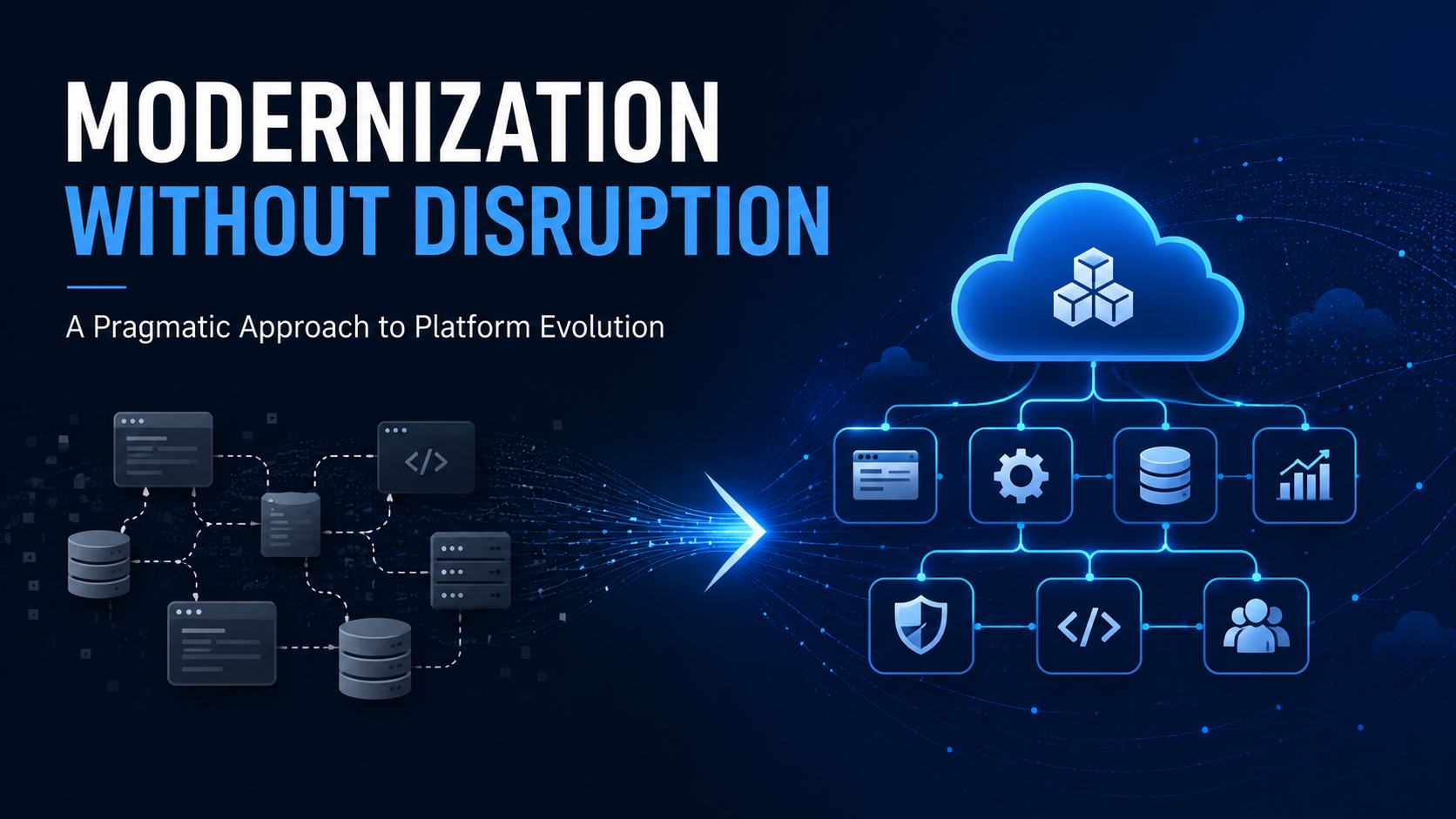
Modernization Without Disruption: A Pragmatic Approach
Many organizations know their platforms need modernization.
The challenge is rarely recognizing the need for change.
The challenge is deciding how to change without disrupting customers, internal teams, or ongoing business operations.
For years, modernization projects have been associated with large-scale platform rebuilds. Entire systems are replaced, teams are reorganized, and timelines stretch far beyond initial expectations.
Unfortunately, many of these initiatives fail to deliver the intended outcomes.
Not because modernization is unnecessary.
But because the approach creates more disruption than value.
Why Modernization Becomes Necessary
Digital platforms evolve over time.
What worked three or five years ago may no longer support current business requirements.
Common signals include:
- Slower release cycles
- Increasing maintenance effort
- Performance limitations
- Security concerns
- Growing technical debt
- Difficulty integrating modern tools and services
- Poor scalability
At some point, the platform begins to limit business growth rather than support it.
That is when modernization becomes a business priority.
The Rewrite Trap
When organizations decide to modernize, the first solution often proposed is:
“Let’s rebuild everything.”
While a complete rebuild may sound appealing, it introduces significant risk.
Large rewrites often involve
- Long delivery timelines
- Increased costs
- Knowledge loss
- Parallel system maintenance
- Delayed business value
Most importantly, they require organizations to wait months or years before seeing meaningful results.
For many businesses, that risk is difficult to justify.
Modernization Is Not a Single Event
Successful modernization is rarely a one-time project.
It is an ongoing process of improving platform capabilities while maintaining operational continuity.
Rather than replacing everything at once, organizations achieve better outcomes through incremental improvements.
This approach allows teams to:
- Reduce risk
- Deliver value faster
- Maintain business continuity
- Learn and adapt throughout the process
Modernization becomes manageable because change happens in controlled stages.
Focus on Business Outcomes First
Technology should never be modernized simply because it is old.
The objective should always be tied to a business outcome.
Examples include:
- Faster product delivery
- Improved customer experience
- Better platform performance
- Reduced operational costs
- Enhanced security and compliance
- Increased scalability
When modernization is linked to measurable outcomes, decision-making becomes significantly clearer.
Areas Often Prioritized for Modernization
Platform Architecture
As systems grow, architecture decisions made years ago may create bottlenecks.
Modernization can improve flexibility, scalability, and maintainability.
User Experience
Customer expectations evolve quickly.
Modern interfaces and improved user journeys often create immediate business value.
Infrastructure
Cloud services, automation, monitoring, and deployment pipelines can improve operational reliability.
Content and Data Management
Organizations often modernize how content and data are structured, managed, and delivered across platforms.
Security and Compliance
Modern security practices help organizations reduce risk while meeting evolving compliance requirements.
A Pragmatic Modernization Framework
Successful teams typically follow a structured approach:
Assess
Understand the current platform, dependencies, risks, and opportunities.
Prioritize
Identify improvements that deliver the highest business value.
Modernize Incrementally
Implement changes in manageable phases rather than large-scale replacements.
Validate
Measure performance, quality, and business outcomes continuously.
Evolve
Treat modernization as an ongoing capability rather than a one-time initiative.
The Role of Engineering Continuity
One of the most overlooked aspects of modernization is continuity.
Organizations often focus heavily on technology while underestimating the importance of knowledge, processes, and delivery consistency.
Sustainable modernization requires:
- Stable engineering practices
- Clear ownership
- Quality standards
- Documentation
- Long-term platform stewardship
Without continuity, even modern platforms can quickly accumulate new technical debt.
What Successful Modernization Looks Like
The most successful modernization initiatives are often the least disruptive.
Customers continue using the platform.
Internal teams remain productive.
Business operations continue uninterrupted.
Yet behind the scenes, engineering teams steadily improve architecture, workflows, performance, security, and scalability.
The result is a platform that evolves alongside business needs instead of requiring periodic reinvention.
Final Thoughts
Modernization does not have to mean starting over.
Organizations that take a pragmatic approach focus on business outcomes, incremental improvements, and operational continuity.
Rather than pursuing large-scale disruption, they create a structured path toward long-term platform evolution.
Modernization succeeds when it enables growth without interrupting the business that depends on it.
About OWLSystems
OWLSystems helps organizations build, modernize, support, and scale digital platforms through structured engineering execution, operational maturity, and long-term ownership.