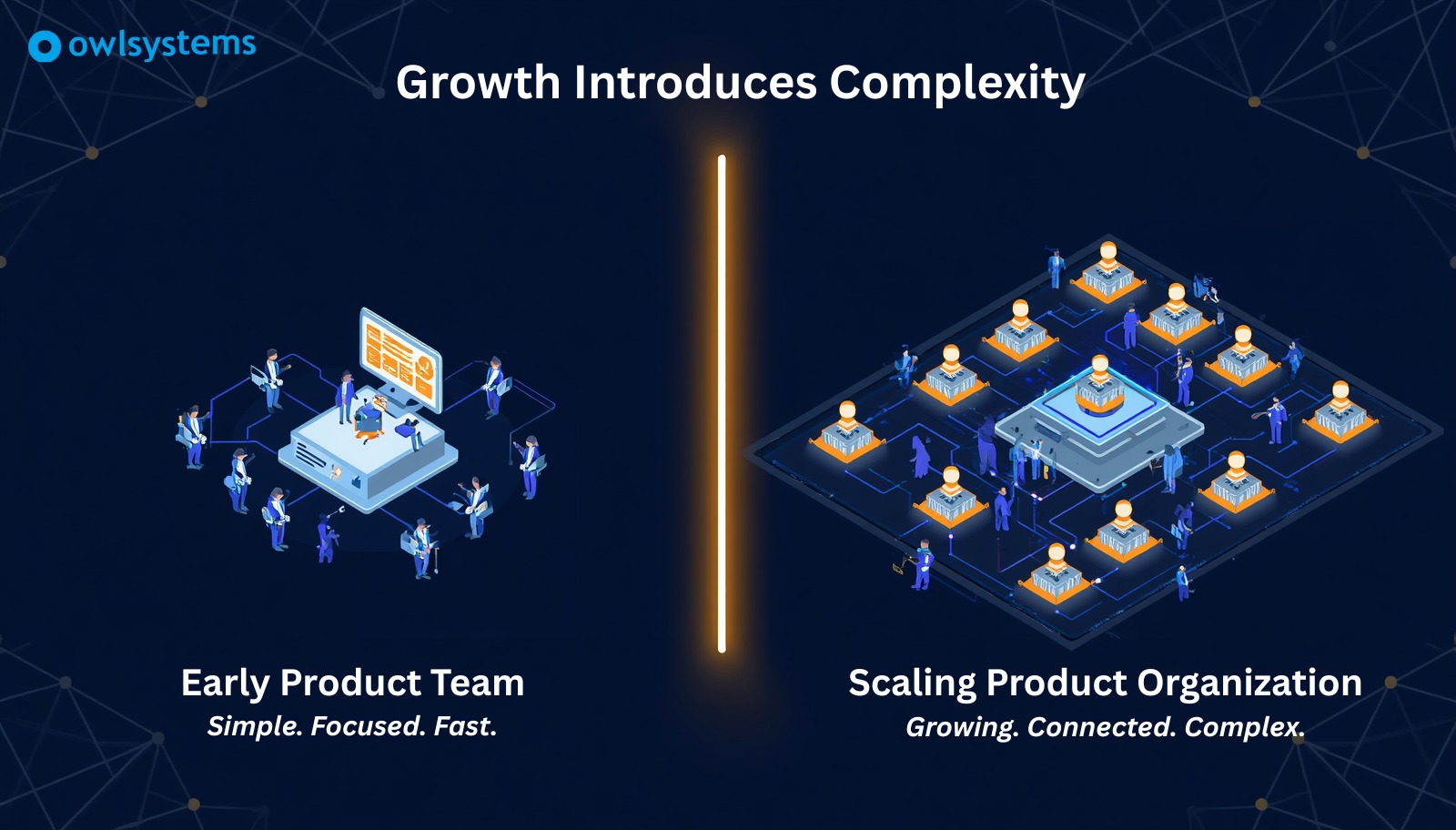
Why Product Teams Slow Down As They Scale
One of the most surprising things we see is that product delivery often slows down after companies grow.
Teams get larger. Budgets increase. More tools are introduced. Yet releases start taking longer, engineering teams feel constantly stretched, and product roadmaps become harder to execute.
At first glance, this seems counterintuitive. More people should mean faster delivery.
In reality, growth introduces complexity. And complexity can slow even the most talented teams if the right engineering foundations are not in place.
The Scaling Paradox
In the early stages of a product, small teams move quickly.
Developers sit close to decision-makers. Communication is simple. Priorities are clear. Most people understand the entire product.
As organizations grow, things change.
New stakeholders become involved. Customer expectations increase. Additional systems and integrations are introduced. Compliance, security, accessibility, and operational requirements become more important.
The challenge is no longer building features. The challenge becomes managing complexity while maintaining delivery momentum.
Everyone Is Working. Nobody Owns It.
One of the most common patterns we encounter is fragmented ownership.
An internal team may manage part of the platform. Contractors handle specific initiatives. External agencies contribute to certain areas. Freelancers support short-term requirements.
Everyone is working. Everyone is delivering something.
Yet when a critical issue arises, nobody can confidently answer:
“Who owns this?”
Without clear ownership, teams spend more time coordinating, clarifying, and troubleshooting than actually delivering value.
The result is slower releases, inconsistent quality, and growing technical debt.
Technical Debt Becomes a Business Problem
Most teams don’t intentionally create technical debt.
It usually develops as products evolve. Short-term decisions are made to meet deadlines. New features are added quickly. Legacy code remains because replacing it is difficult.
Over time, these decisions accumulate.
Eventually, every new release takes longer. Testing becomes more complicated. Bugs become harder to trace. Engineering confidence decreases.
What started as an engineering concern becomes a business constraint.
More People Doesn’t Always Mean Faster Delivery
Adding engineers can solve a capacity problem.
It can also create a coordination problem.
As teams grow, communication overhead increases significantly. More meetings are required. More dependencies emerge. More decisions need alignment.
We’ve seen organizations double their engineering capacity only to discover that delivery speed remained largely unchanged.
The issue wasn’t talent.
The issue was structure
Engineering Standards Matter More Than Most Teams Realize
As products mature, consistency becomes critical.
Without clear engineering standards, teams often experience:
- Inconsistent architecture decisions
- Documentation gaps
- Variable code quality
- Knowledge silos
- Increased operational risk
High-performing teams don’t rely on individual heroics.
They create repeatable processes that allow engineering quality to scale alongside the business.
What Successful Product Teams Do Differently
Over the years, we’ve observed several patterns among teams that continue delivering effectively as they grow.
They Prioritize Structure
Successful teams invest in engineering governance, coding standards, review processes, and architectural consistency.
This creates predictability and reduces unnecessary complexity.
They Think Beyond Feature Delivery
Deployment is not the finish line.
Strong engineering organizations plan for ongoing maintenance, monitoring, optimization, and continuous improvement from the beginning.
They Establish Clear Ownership
The most effective teams remove ambiguity.
Everyone understands who owns what, how decisions are made, and how accountability is maintained.
They Build For Continuity
Instead of constantly rebuilding delivery capacity, mature organizations create stable engineering structures that can evolve alongside the product.
The Role of Engineering Partnerships
As products grow, many organizations discover they need more than additional developers.
They need partners who can provide:
- Structured engineering execution
- Long-term continuity
- Scalable delivery capacity
- Operational maturity
- Clear accountability
The goal is not simply to deliver features faster.
The goal is to create an engineering environment that can sustain growth without sacrificing quality, reliability, or visibility.
What We’ve Learned
Over the years, we’ve noticed something consistent.
The product teams that scale successfully aren’t always the ones with the largest budgets or the biggest engineering departments.
They’re usually the teams that create clarity.
Clear ownership.
Clear standards.
Clear processes.
Clear accountability.
When those foundations are in place, growth becomes much easier to manage.
When they’re missing, every new feature, new team member, or new initiative adds complexity.
Engineering capacity matters.
But engineering maturity is what allows organizations to scale with confidence.
The teams that continue growing successfully are not simply building products.
They’re building systems, processes, and partnerships that support long-term success.